On a quiet morning in central Israel, a cow named Ruthi stands in the sun as a young calf presses close, nursing gently.
It may look ordinary- until you know the story.
When Ruthi arrived at Freedom Farm Sanctuary in the center of Israel, she was 13 years old- the oldest cow in Israel at the time. She arrived in poor condition, with enlarged and inflamed udders. She had spent her entire life in the dairy industry, enduring 11 pregnancies. Each time, her calves were taken from her shortly after birth so her milk could be used. Loss wasn’t an exception. It was her routine.
And then, something unexpected happened.
When her body could no longer survive another pregnancy, the farmer who had come to know her made a different choice. Instead of sending her to slaughter, he chose to let her live- and brought her to Freedom Farm Sanctuary.
Healing, as it turns out, is slow work.
It took time. Space. Safety. The kind of care most of us assume should be a given- but rarely is.

And then, something quietly miraculous unfolded.
A young calf named Tamar, only a few days old and still with her umbilical cord attached, arrived at the sanctuary after being found wandering alone. One day, she approached Ruthi and began to nurse. Against all odds, Ruthi’s body responded. At 13, she began producing milk again.
For the first time in her life, she was allowed to be a mother- without interruption, without separation.
For months, she cared for Tamar.
It was a repair for both of them:
Ruti, finally, got to mother.
Tamar, finally, got a mother.

Why This Kind of Place Matters
Stories like Ruthi’s aren’t rare at Freedom Farm Sanctuary- they are the reason it exists.
Home to more than 400 rescued animals, the sanctuary is a refuge for cows, pigs, chickens, goats, sheep, turkeys, and others who have been pulled from the food industry and laboratory environments. But this isn’t just about rescue.
It’s about re-seeing.
Because at its core, Freedom Farm is built on a belief that feels almost radical in today’s world: that animals are not categories- they are individuals. With personalities. With emotional lives. With the ability to heal when given the chance.
And just as importantly- it’s a place that gently asks us to reconsider our relationship with them.
Not Just for Animals
Something else happens here, too.
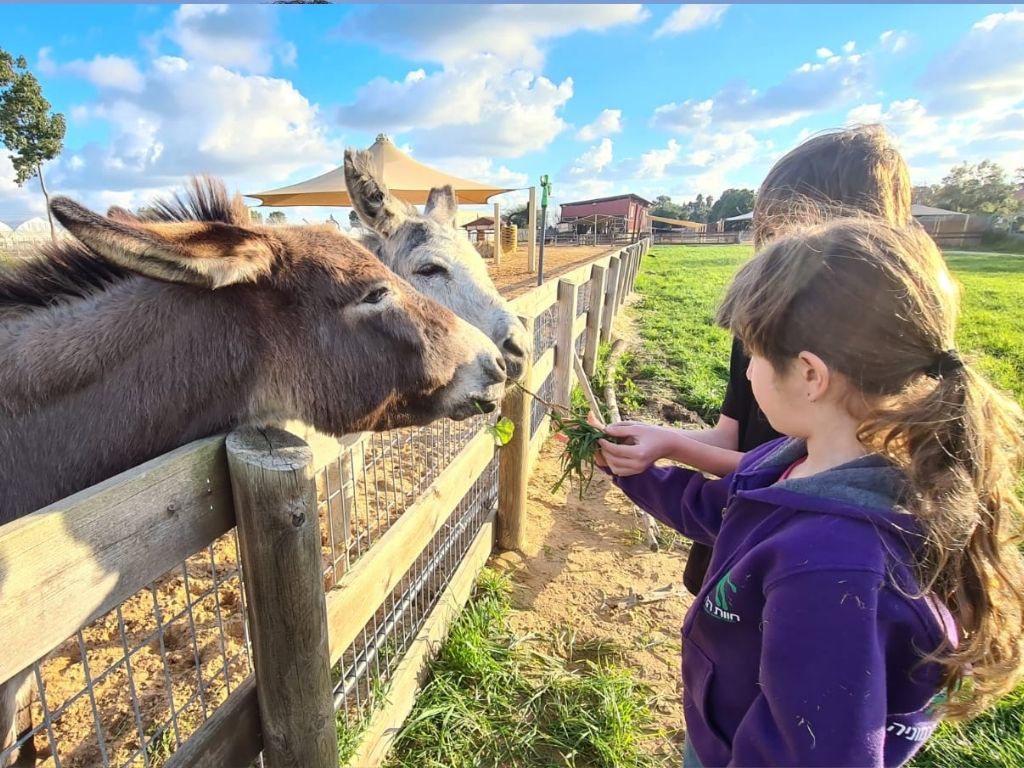
Freedom Farm has quietly become a space for people- especially those who need it most.
School groups, at-risk youth, children with special needs, and individuals navigating mental health challenges arrive at the farm and are invited into something different. Slower. Softer. More present.
This isn’t passive learning.
It’s participation.
Feeding. Cleaning. Sitting. Showing up.
And in that process, something shifts.
For many- sometimes for the first time- they move from being cared for to becoming caregivers themselves. That transition, small as it may look from the outside, can be everything.
Because when you are trusted to care for another living being, something inside you reorganizes.
There’s a word for that, though we don’t always use it in lifestyle spaces:
Meaning.

Compassion as a Practice
We talk a lot about self-care. About wellness. About living balanced lives.
But what if compassion is also a practice?
At Freedom Farm Sanctuary, compassion is seen as a muscle—one that strengthens the more we use it.
And on the farm, it shows up in small, almost imperceptible moments:
a gentle hand brushing through fur,
a breath slowing down,
a deep, steady gaze between species,
an animal choosing to stay close.
These are not dramatic moments. They don’t go viral.
But they change people.


And Then, Reality Shifted
Since the outbreak of war, this quiet sanctuary has been pulled into a very different reality.
Caring for hundreds of vulnerable animals- many with disabilities or trauma histories- was never simple. Now, it happens under the constant weight of uncertainty, emotional strain, and security threats.
Staff and volunteers continue to show up, even under missile fire. They carry their own fear, their own exhaustion- and still, they care.
At the same time, the sanctuary itself has been deeply impacted. Visits and tours- once a vital source of income- can no longer take place. And it now faces a growing financial challenge.
Which raises a question that feels very aligned with the kind of conversations we’re having more and more lately:
What do we choose to support?

Choosing a Different Kind of World
Freedom Farm Sanctuary was founded in 2016 by Adit Romano and Meital Ben Ari, two businesswomen, out of a deeply rooted idea: to teach compassion toward the most vulnerable- animals in the food industry, as a way to build a more just and empathetic society.
Since then, they have faced ongoing challenges- logistical, emotional, and in recent years, increasingly complex realities on the ground. And yet, despite it all, through hard work and a deep understanding of the immense responsibility they carry, one that does not allow them to give up, the sanctuary continues to grow.
What began as a local initiative has evolved into something much larger: a social movement. Today, Freedom Farm has built a global community of hundreds of thousands of followers and supporters, people who connect to its message of compassion, healing, and conscious living.
It’s not loud work.
It doesn’t always fit neatly into headlines.
But it matters.
Because in a world that often feels fast, disconnected, and overwhelming, places like this remind us of something essential:
That softness is not a weakness.
That care is not naive.
And that choosing compassion- again and again- is still one of the most powerful things we can do.
If this kind of world speaks to you, you’re invited to follow along and be part of the journey.

FOLLOW FREEDOM FARM SANCTUARY: