
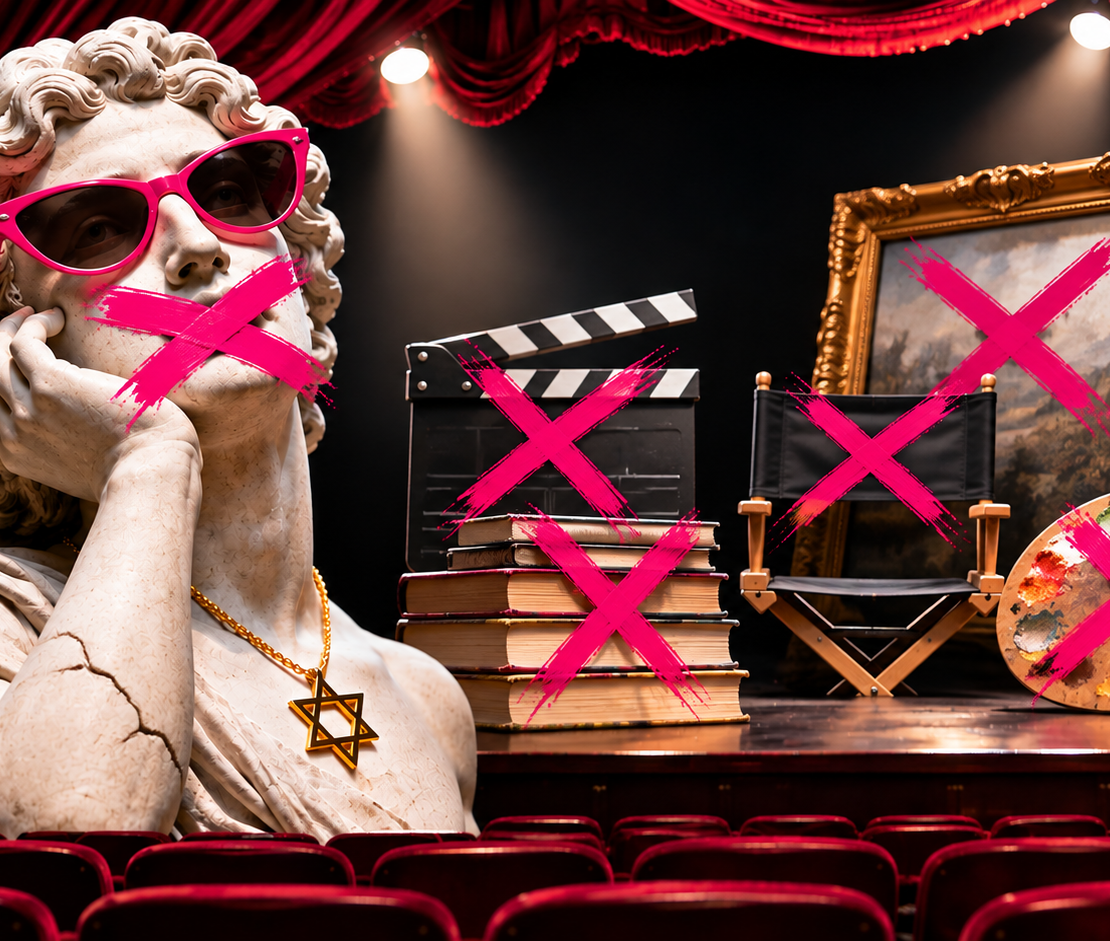

Diversity for Everyone. Except the Jews, Apparently.
America’s museums, publishing houses, and performing arts institutions have a Jewish problem. A sweeping new ADL investigation reveals just how deep the hypocrisy goes.
Apparently, diversity is our strength. Unless you’re Jewish. Then it’s a scheduling conflict, a security concern, a controversial manuscript, or an unfortunate inconvenience to the DEI committee.
Welcome to the American arts establishment, where everyone gets a seat at the table, provided nobody at the table has an Israeli grandmother, a Hebrew name, or the audacity to believe Jews deserve self-determination.
For years, we’ve watched cultural institutions drape themselves in the language of inclusion while Jewish artists, writers, musicians, and performers have increasingly found themselves on the wrong side of an invisible velvet rope.
Now, thanks to a sweeping investigation by the Anti-Defamation League (ADL), we have something considerably more damning than anecdotal evidence.
We have receipts. And they’re ugly.
Released in October 2026, ADL’s State of the Arts initiative examines Jewish exclusion across three pillars of American culture: museums, publishing, and live entertainment. The findings read like a master class in how to make discrimination sound terribly sophisticated.
Because apparently, the same institutions that can produce a 47-page diversity statement are struggling with the concept that Jews are people, too.
Museums: Everyone’s Heritage Matters. Well, Almost Everyone’s.
Let’s begin with the institutions that have made inclusion practically a competitive sport.
In its report Behind the Frame, ADL evaluated 40 American art museums, examining their policies, representation of Jewish and Israeli artists, and public programming.
Only ONE museum out of 40 earned the highest rating, Gold Standard: the Berkeley Art Museum & Pacific Film Archive.
The Cleveland Museum of Art and Detroit Institute of Arts were among the stronger performers, receiving a Good Showing rating.
Meanwhile, 12 museums, a full 30 percent, received the lowest rating: Critically Deficient.
Among them? The Philadelphia Museum of Art and The Broad.
Yes, The Broad.
The museum where you can immerse yourself in contemporary art, ponder the human condition, and apparently encounter a rather conspicuous gap in the institution’s approach to Jewish inclusion.
But the most astonishing finding concerns Jewish American Heritage Month.
In 2026, just one of the 40 museums demonstrated recognition of Jewish American Heritage Month, while 24 continued recognizing other heritage months.
And here’s where things get especially interesting.
Before October 7, 2023, six of the museums had recognized Jewish American Heritage Month. By 2026, five had stopped, while the remaining institution had not offered dedicated programming.
Let that sink in.
At precisely the moment Jewish Americans were confronting heightened hostility, institutions supposedly devoted to representation were retreating from publicly celebrating Jewish heritage.
The timing is rather extraordinary, isn’t it?
We’re talking about a people whose contributions to American art, music, literature, theater, architecture, photography, and film are so immense that removing them from the cultural conversation would leave approximately three paintings, a folding chair, and someone playing the recorder.
Jewish culture is apparently wonderful as long as nobody mentions the Jews.
And the hypocrisy? Museum-quality.
Someone should frame it.
To be clear, ADL’s assessment covers a selected cross-section of 40 museums, not every museum in America. Nor does a poor rating establish that every person working at an institution harbors prejudice. But these are institutional choices, and institutional choices deserve scrutiny.
If your diversity policy somehow manages to exclude Jewish people, perhaps it’s time to revisit your definition of diversity.
Publishing: Your Book Is Wonderful. Could You Just Make It Less Jewish?
Next up: publishing.
You know, the industry that celebrates banned books, marginalized voices, intellectual freedom, and the sacred importance of telling stories that make people uncomfortable.
Unless, apparently, the discomfort involves a Jewish author who refuses to apologize for existing.
ADL’s Missing Chapter report draws on more than 30 interviews with authors and publishing professionals, alongside documented incidents, to identify seven troubling patterns.
And some of them sound like they were lifted from a particularly dystopian satire.
Jewish and Israeli authors describe being pressured to remove Hebrew words from manuscripts, eliminate Israeli settings, and change Jewish-sounding character names.
Imagine telling a Black author to make her characters sound less Black.
Imagine telling a Muslim author to remove Arabic because it might make a publisher nervous.
The industry would rightly erupt.
But when Jewish authors describe comparable pressure, suddenly everyone becomes terribly interested in nuance, market considerations, and the delicate sensitivities of the acquisition department.
Then there are the blacklists.
The report describes a viral spreadsheet categorizing authors according to perceived political beliefs and encouraging readers to boycott their work.
A spreadsheet.
Because apparently blacklisting people is perfectly acceptable when you give it the aesthetic of an office productivity tool.
In 2024, more than 1,000 writers signed a letter calling for a boycott of Israeli publishing institutions.
Authors have also described being excluded from festivals, targeted by online harassment, and subjected to Goodreads review-bombing before their books were even available to read.
Imagine receiving one-star reviews from people who haven’t read your book, because your identity has become the plot twist they object to.
The report also documents Jewish, Israeli, and Zionist authors struggling to secure or retain literary representation, with some reporting that their identities or beliefs, rather than their writing, were considered professionally risky.
Photographer and author Alyssa Rosenheck describes seeing professional doors close after she began speaking publicly about Jew hatred and Israel’s right to exist.
And what about the institutions supposedly protecting writers?
ADL criticizes organizations including the Authors Guild and PEN America for responses it characterizes as insufficiently direct in naming anti-Jewish discrimination.
Apparently, the industry that gave us a million books about finding your voice is struggling to defend Jewish people who use theirs.
Here’s the thing: no publisher is obligated to publish every manuscript, and readers are free to disagree with an author’s politics.
But when an author’s Jewish identity, nationality, or belief in Jewish self-determination becomes a reason for professional exclusion, we’ve crossed a rather important line.
That’s not literary criticism.
That’s discrimination wearing reading glasses.
The Performing Arts: The Show Must Go On. Unless the Performer Is Israeli.
Now for the stage.
ADL’s Dark Stage report and accompanying case archive document 65 cases across 41 U.S. locations, involving protests, disruptions, targeting, and cancellations affecting Jewish, Israeli, and openly Zionist performers.
The cases span live music, comedy, dance, film, and campus programming, with documented incidents extending through August 2026.
Among the artists and ensembles caught in these controversies are Matisyahu, the Batsheva Dance Company, and the Israel Philharmonic.
Let’s discuss the astonishing logic of protesting a dance company because of the nationality of its dancers.
A dance company.
People who have devoted their lives to communicating through movement, expression, and art.
Apparently, the path to peace now involves making sure nobody gets to see a pirouette.
The report also identifies what amounts to a “security veto.”
In cases involving musicians Mikey Pauker and Raviv Kaner, concerns about possible protests contributed to canceled performances.
Think about the implications.
If organizers cancel a Jewish or Israeli artist because someone might protest, the people threatening disruption effectively acquire the power to determine who gets a stage.
Since when did threatening to silence an artist become a legitimate reason to silence the artist?
Of course, people have the right to protest. They have the right to criticize Israel, object to political positions, and decline to attend performances.
But the right to protest is not a universal backstage pass to intimidate artists into professional oblivion.
And the responsibility of cultural institutions is not merely to avoid controversy.
It’s to defend the freedom of artistic expression, especially when doing so requires a little backbone.
A quality currently in shorter supply than affordable Broadway tickets.

The Public Isn’t Necessarily Demanding This. So Who Is?
Here’s where the story becomes particularly revealing.
Alongside its investigations, ADL surveyed 951 U.S. adults about Jewish and Israeli participation in the arts.
Among respondents:
- 88 percent said they would visit a gallery featuring Jewish artists.
- 87 percent said they would attend a performance featuring Jewish performers.
- 84 percent said they would buy a book featuring Jewish subjects or characters.
When asked about Israeli artists, support remained substantial: 77 percent for galleries, 75 percent for performances, and 73 percent for books.
Now, an important caveat: this was an online, non-nationally representative survey. These figures describe its respondents, not a scientifically established percentage of all Americans.
Still, the findings raise an uncomfortable question.
If so many surveyed consumers are willing to engage with Jewish and Israeli art, why are some institutions behaving as though featuring it is a reputational emergency?
ADL’s companion investigation from its Center on Extremism examines activist networks that organize pressure campaigns targeting cultural institutions and Jewish or Israeli participation.
This is where we need to distinguish between political dissent and identity-based exclusion.
Criticizing the policies of the Israeli government is legitimate political expression.
Deciding that a Jewish musician, novelist, painter, or dancer should be denied an opportunity because of their nationality, identity, or presumed beliefs is something else entirely.
And dressing that exclusion in the language of justice doesn’t magically make it just.
It simply makes it easier for institutions to pretend they’re doing the right thing.
And that, darling, is how prejudice acquires a respectable wardrobe.
When Inclusion Becomes Selective, It Stops Being Inclusion.
I’ve spent years writing about feminism, equality, animal rights, social justice, and the obligation to stand up for people whose voices are being marginalized.
I believe in those principles just as fiercely today.
Which is precisely why I refuse to accept the increasingly fashionable notion that Jewish people somehow fall outside them.
You cannot champion representation and then decide Jewish representation is negotiable.
You cannot celebrate marginalized voices while demanding that Jewish authors edit themselves into invisibility.
You cannot call yourself a defender of artistic freedom while allowing intimidation to determine who gets to perform.
And you certainly cannot spend years preaching that silence is violence, only to discover a newfound appreciation for silence when Jewish people are the ones being targeted.
The most insidious discrimination doesn’t always arrive waving a flag or shouting a slur.
Sometimes it arrives as an editorial suggestion.
A canceled booking.
A quietly withdrawn invitation.
A heritage month that mysteriously disappears from the calendar.
A polite email explaining that, unfortunately, the timing just isn’t right.
And because each decision can be explained away individually, the broader pattern becomes easier to ignore.
That’s what makes this investigation so important.
It asks us to look beyond isolated incidents and examine what happens when the cumulative effect of supposedly small decisions is to make Jewish identity less visible, less welcome, and more professionally costly.
The arts are supposed to challenge prejudice, not provide it with excellent lighting and a beautifully designed program.
And the Jewish community should not have to beg for inclusion from institutions that have made inclusion their entire brand identity.
So here’s a radical idea for America’s museums, publishers, and performing arts institutions: If you’re going to preach inclusion, try including the Jews.
We promise not to ruin the aesthetic.
By Chloé Jo Davis | GirlieGirl Army
Source: ADL’s October 2026 State of the Arts research initiative, including Behind the Frame, Missing Chapter, Dark Stage, the Dark Stage Case Archive, the accompanying audience survey, and the Center on Extremism investigation. Museum ratings reflect ADL’s assessment methodology, and publishing allegations are drawn from interviews and documented cases described in its report.